


Galvanized Wire Mesh Opening Size and Wire Diameter: How to Choose the Right Specifications
Understanding Mesh Dimensions, Open Area, Weight and Practical Applications
When purchasing galvanized wire mesh, buyers often focus on two basic specifications: mesh opening size and wire diameter.
These dimensions may appear simple, but they have a direct influence on the finished product's structure, weight, material consumption and suitability for different applications.
A galvanized wire mesh with large openings and thin wires behaves differently from one with smaller openings and thicker wires. Even when two products have similar overall dimensions, their weight, rigidity and price can vary considerably.
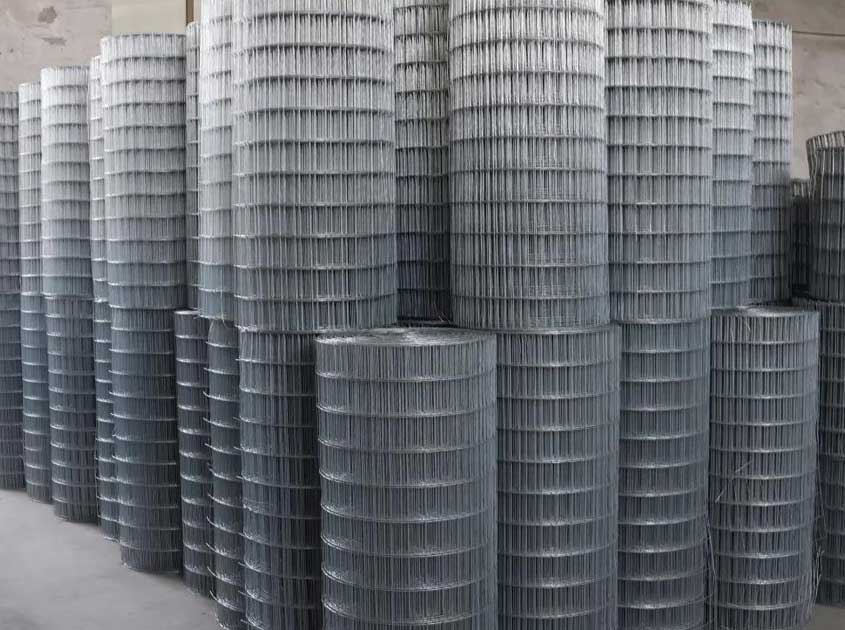
For importers, distributors, contractors and industrial buyers, understanding these specifications is essential for comparing quotations and ordering the correct product.
This guide explains how mesh opening size and wire diameter work together, how to measure them correctly, and how to select suitable galvanized wire mesh for different applications.
1. What Is Mesh Opening Size?
Mesh opening size refers to the clear distance between two adjacent wires in a wire mesh structure.
It determines how large the openings are and influences the passage of materials, airflow, visibility and particle retention.
For example, galvanized wire mesh may be manufactured with openings such as:
6.3 mm × 6.3 mm
12.7 mm × 12.7 mm
19 mm × 19 mm
25.4 mm × 25.4 mm
50 mm × 50 mm
These are illustrative opening dimensions, not universal standard sizes. Actual specifications depend on the product type and manufacturing requirements.
Clear Opening vs. Center-to-Center Spacing
One common source of misunderstanding is the difference between clear opening and wire spacing.
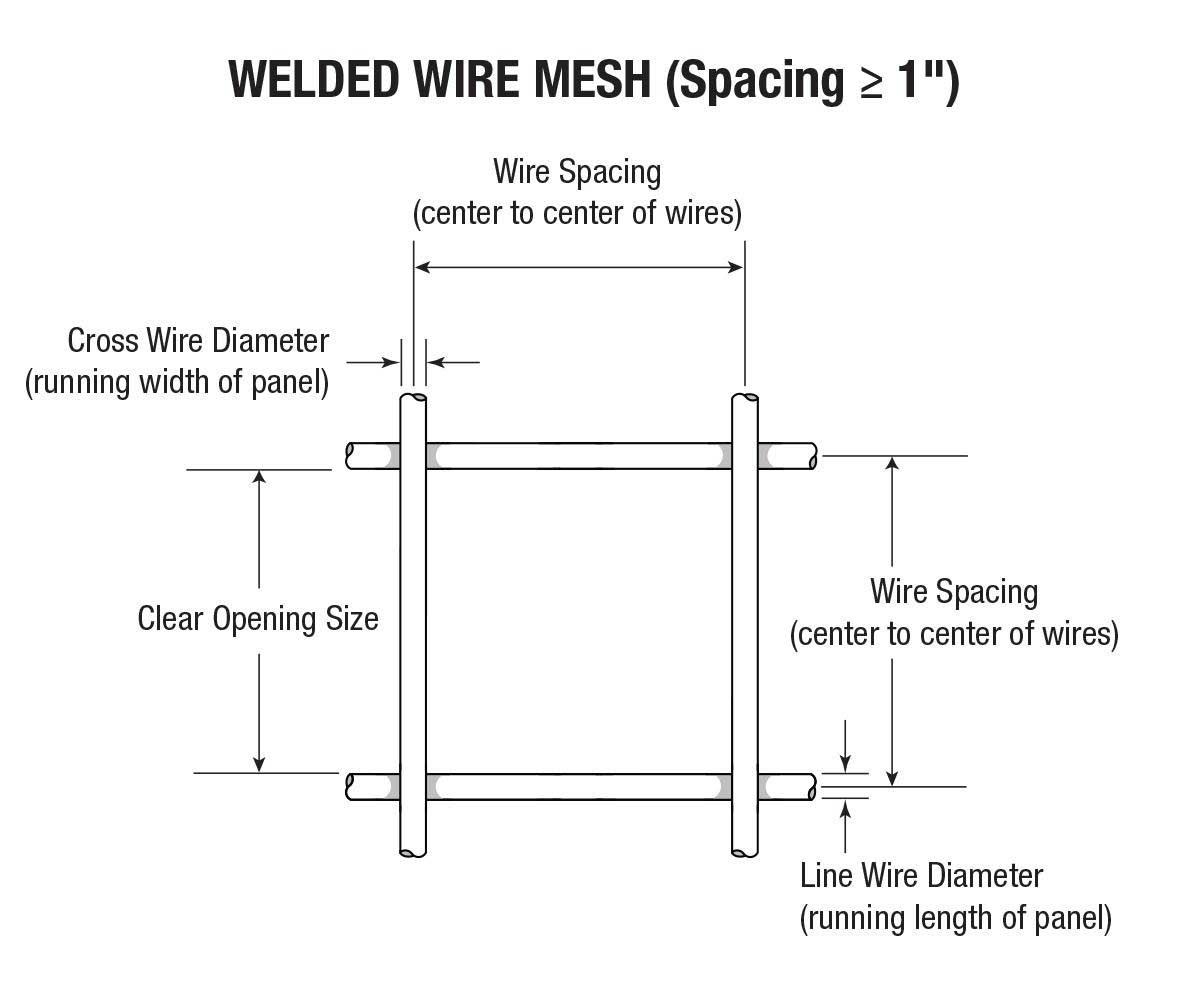
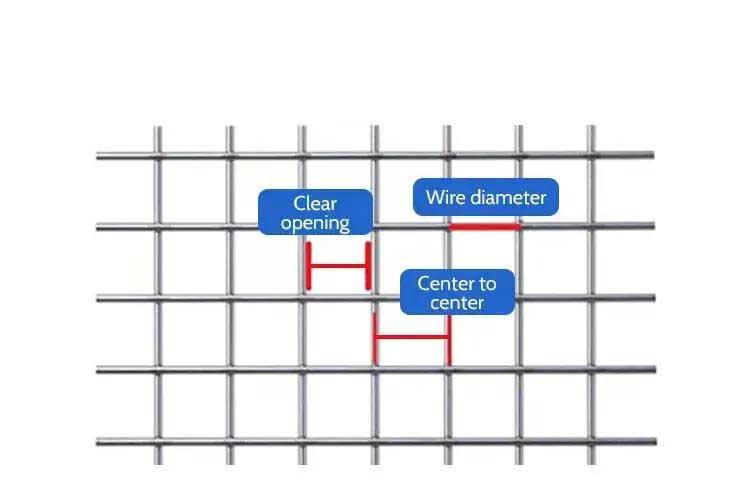
Clear opening is the actual open distance between the surfaces of two neighboring wires.
Center-to-center spacing measures the distance from the center of one wire to the center of the next.
For a regular square welded mesh, the relationship is:
Center-to-center spacing = Clear opening + Wire diameter
For example, if the clear opening is 25 mm and the wire diameter is 2 mm, the center-to-center spacing is 27 mm.
When requesting a quotation, always clarify whether the specified mesh size refers to the clear opening or the center-to-center distance.
This small detail can prevent significant specification differences between suppliers.
2. What Is Wire Diameter?
Wire diameter refers to the thickness of the individual steel wire used to manufacture the mesh.
It is commonly measured in millimeters (mm).
Some buyers also use wire gauge systems such as BWG or SWG, depending on the product and market. Because different gauge systems may use different conversion values, specifying the diameter in millimeters is generally clearer when comparing international quotations.
Typical illustrative wire diameters include:
Wire Diameter
General Description
0.5–0.8 mm Fine wire applications
0.9–1.2 mm Light-duty mesh
1.3–1.8 mm General-purpose mesh
2.0–2.5 mm Medium-duty mesh
2.6–3.5 mm Heavier mesh constructions
Above 3.5 mm Heavy-duty applications, depending on structure
These ranges are only general purchasing references. The suitable wire diameter depends on the mesh construction, opening size, installation method and expected loads.
Why Does Wire Diameter Matter?
Wire diameter influences several important characteristics:
Mechanical strength
Thicker wires generally provide greater resistance to deformation, although actual performance also depends on steel grade, weld quality, support spacing and installation conditions.
Product weight
Increasing wire diameter increases steel consumption. This can noticeably affect the weight and material cost of a mesh product.
Mesh rigidity
A mesh made with thicker wires may be more rigid and easier to maintain in shape, depending on its dimensions and construction.
Coating requirements
The wire diameter and galvanizing process influence how the zinc coating is specified and measured. Buyers should clarify whether the quoted diameter refers to the steel core or the finished galvanized wire.
3. How Do Mesh Opening Size and Wire Diameter Work Together?
Mesh opening size and wire diameter should never be evaluated independently.
Together, they define the geometry of the mesh structure.
Consider three simplified examples of square welded wire mesh:
Clear Opening
Wire Diameter
Center-to-Center Spacing
25 mm × 25 mm 1.5 mm 26.5 mm
25 mm × 25 mm 2.0 mm 27 mm
25 mm × 25 mm 3.0 mm 28 mm
All three products have the same nominal clear opening, but their wire thickness and material consumption are different.
The thicker-wire version generally contains more steel and may provide greater rigidity, but it also costs more and weighs more.
Now consider a different comparison:
Clear Opening
Wire Diameter
Center-to-Center Spacing
12 mm × 12 mm 1.5 mm 13.5 mm
25 mm × 25 mm 1.5 mm 26.5 mm
50 mm × 50 mm 1.5 mm 51.5 mm
Here, the wire diameter remains unchanged while the opening size increases.
The resulting products have different open areas, mesh densities and material consumption per unit area.
This is why a complete mesh specification must include both opening size and wire diameter.
4. Open Area: The Connection Between Opening Size and Wire Diameter
Open area is the percentage of the mesh surface that consists of openings rather than wire.
It is an important consideration in applications involving airflow, visibility, drainage, screening and material passage.
For a regular square mesh with equal wire diameters in both directions, open area can be estimated from the clear opening and wire diameter.
For example:
A mesh with relatively large openings and thin wires has a higher open area.
A mesh with smaller openings and thicker wires has a lower open area.
A higher open area can allow more material to pass through, but it may provide less physical coverage and may not retain smaller particles.
A lower open area can improve screening for certain applications, but it may restrict airflow or material flow.
The best balance depends on the actual application.
Why Open Area Matters in Different Applications
Agricultural applications
Open area affects ventilation, visibility and the containment of animals or materials.
Construction applications
The relationship between opening size and wire diameter influences the mesh's suitability for general reinforcement-related or protective applications. Structural reinforcement requires the appropriate engineered product and applicable specifications.
Industrial screening
Opening dimensions influence which particles can pass through the mesh, while wire thickness affects the physical construction and potential wear resistance.
Fence applications
Mesh opening and wire diameter influence visibility, security characteristics and the overall appearance of the fence.
5. How Do These Specifications Affect Galvanized Wire Mesh Weight?
Weight is one of the most important factors affecting galvanized wire mesh purchasing costs, especially for large-volume orders and international shipping.
For a regular square welded mesh, both the wire diameter and wire spacing influence the amount of steel used per square meter.
In general:
Thicker wire increases the weight.
Smaller openings increase the number of wires per unit area.
Larger openings reduce the number of wires per unit area when wire diameter remains unchanged.
Galvanized coating adds some weight to the finished product.
This explains why two galvanized welded mesh products with identical roll dimensions may have different weights.
Why Buyers Should Compare Weight Carefully
Suppose two suppliers quote galvanized welded wire mesh with the same roll width, length and nominal opening.
Supplier A offers 2.0 mm wire, while Supplier B offers 2.5 mm wire.
The second product will generally use more steel, so its theoretical weight and material cost will be higher.
However, buyers should not evaluate quality through weight alone.
A higher product weight does not automatically mean better quality. The actual wire diameter, coating condition, mesh dimensions, weld integrity and dimensional tolerances must also be checked.
For large-volume procurement, it is useful to request both theoretical and actual product weights and clarify how the manufacturer calculates them.
6. How to Choose the Right Opening Size and Wire Diameter for Different Applications
Different applications require different combinations of mesh opening and wire diameter.
There is no single specification suitable for every galvanized wire mesh product.
Construction and General Building Applications
For construction-related applications, buyers should consider:
Required mesh opening
Wire diameter
Panel or roll dimensions
Installation and support conditions
Applicable construction standards
For concrete reinforcement, the mesh must meet the specified reinforcement requirements. Ordinary galvanized wire mesh should not automatically be treated as structural reinforcing mesh.
Agricultural and Animal Enclosures
For agricultural applications, the opening size should be selected according to the animals, poultry or materials being contained.
Wire diameter should be evaluated according to expected contact, impact, enclosure dimensions and support arrangements.
Smaller openings may be useful for containing smaller animals, while larger openings may be appropriate for some general agricultural barriers.
For predator protection, ordinary lightweight mesh may be insufficient. Stronger wire, suitable opening dimensions and secure installation details may be necessary.
Industrial Screening and Filtration
For screening applications, the opening size is closely related to the required separation size.
Wire diameter should be balanced against flow requirements, wear, mechanical handling and expected operating conditions.
For precision filtration, the actual aperture and applicable filtration rating should be confirmed rather than relying only on a nominal mesh description.
Fence and Security Applications
For fencing, opening size affects visibility, passage prevention and the physical structure of the barrier.
Wire diameter contributes to the overall rigidity and resistance to deformation.
For example, a lightweight garden fence and a perimeter fence for an industrial facility require different combinations of opening size, wire thickness, panel dimensions and support structures.
7. Galvanized Wire Diameter: Before or After Coating?
This is an important detail that international buyers should confirm when ordering galvanized wire mesh.
The diameter of galvanized wire can refer to two different measurements:
Base steel wire diameter
This is the diameter of the steel wire before the zinc coating is applied.
Finished galvanized wire diameter
This is the measured outside diameter after galvanizing.
Because zinc coating adds material to the wire surface, the finished diameter may be slightly larger than the base steel diameter.
The difference depends on the coating thickness and measurement method.
For example, if a quotation specifies 2.0 mm galvanized wire, the buyer should confirm whether 2.0 mm refers to the steel core or the finished coated wire.
This is especially important when comparing quotations from different manufacturers.
The buyer should also clarify:
Galvanizing process
Zinc coating mass or thickness
Relevant product standard
Measurement method
Permitted dimensional tolerances
A correct diameter specification helps prevent misunderstandings about material consumption, product weight and finished mesh dimensions.
8. Common Mistakes When Ordering Galvanized Wire Mesh
Even experienced buyers can encounter specification problems when product requirements are not clearly documented.
Here are six mistakes worth avoiding.
Mistake 1: Specifying only the mesh opening
Opening size alone does not define the complete mesh structure. Always include wire diameter.
Mistake 2: Confusing clear opening with center spacing
These measurements are different and can result in products with different dimensions.
Mistake 3: Ignoring the galvanized coating
A wire diameter measured before coating may differ from the finished outside diameter.
Mistake 4: Choosing thicker wire without considering the application
A heavier mesh may increase cost and shipping weight without providing a meaningful benefit for the intended use.
Mistake 5: Comparing quotations only by price per roll
Compare the actual specifications, dimensions, weight, coating requirements and packaging conditions.
Mistake 6: Failing to confirm tolerances
Manufacturing tolerances should be agreed upon before production, particularly for projects requiring consistent dimensions across large quantities.
9. What Information Should You Include in a Galvanized Wire Mesh Inquiry?
To receive an accurate quotation, provide a complete specification instead of simply requesting a price for galvanized wire mesh.
A useful inquiry checklist includes:
Specification
Information to Provide
Product type Welded mesh, woven mesh or another construction
Mesh opening Clear opening in mm or inch
Wire diameter Steel core or finished galvanized diameter
Material Low carbon steel or other specified material
Surface treatment Electro-galvanized or hot-dip galvanized, as applicable
Zinc coating Required coating mass or relevant standard
Mesh dimensions Width, length, panel size or roll size
Mesh shape Square, rectangular or custom opening
Application Construction, agriculture, fencing, screening or filtration
Quantity Rolls, panels or total square meters
Packaging Standard export packaging or customized requirements
If you have an existing sample, technical drawing or previous purchase specification, sharing it with the supplier can make the quotation process more accurate.
Conclusion: A Good Galvanized Wire Mesh Specification Starts with the Right Combination
Mesh opening size and wire diameter are two fundamental specifications that determine the structure of galvanized wire mesh.
Opening size influences the available passage area, while wire diameter affects material consumption, product weight and structural characteristics.
Together, they influence open area, application suitability, manufacturing cost and the final purchasing decision.
For buyers, the most reliable approach is to define the clear opening, wire diameter, coating requirements, product dimensions and application before comparing quotations.
At Qunkun Metal, we manufacture and supply galvanized wire mesh for construction, agriculture, fencing, industrial screening and other applications.
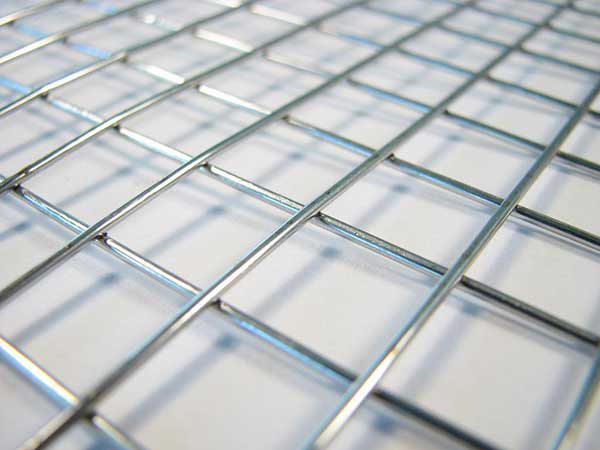
With more than 30 years of manufacturing and export experience, our team can assist buyers in discussing mesh specifications, wire diameters, opening dimensions, galvanizing options and customized product requirements.
Contact Qunkun Metal to discuss your galvanized wire mesh specifications and request a factory quotation.



- Tel.: +86 311 83077076
- E-mail: sales@qunkunmetal.com
- Skype: qunkunsales01
- WhatsApp: 8618032412189
- Add.: No.69 The Filter Industrial Park of Anping, Hebei, China


